




May 19, 2026
The Modern Analyst Problem
Every analyst knows the pressure.
A long PDF arrives late in the evening. A strategy deck needs to be reviewed before tomorrow’s leadership meeting. A transcript has to be analyzed for key signals. A regulatory filing needs to be compared against last quarter’s disclosures. A research report has to be converted into a client-ready brief.
The deadline is urgent. The documents are dense. The expectations are high.
Analysts across finance, consulting, pharma, strategy, research, and enterprise teams spend hours reading, extracting, comparing, validating, formatting, and rewriting information before they can even begin the real work: thinking.
This is the modern analyst problem.
The analyst’s value is not in manually scanning pages. It is not in copying tables into slides. It is not in repeatedly summarizing documents. The analyst’s real value lies in interpretation, judgment, synthesis, and decision support.
Yet in many organizations, analysts spend more time processing documents than generating insights.
That is the workflow SparLM™ is designed to change.
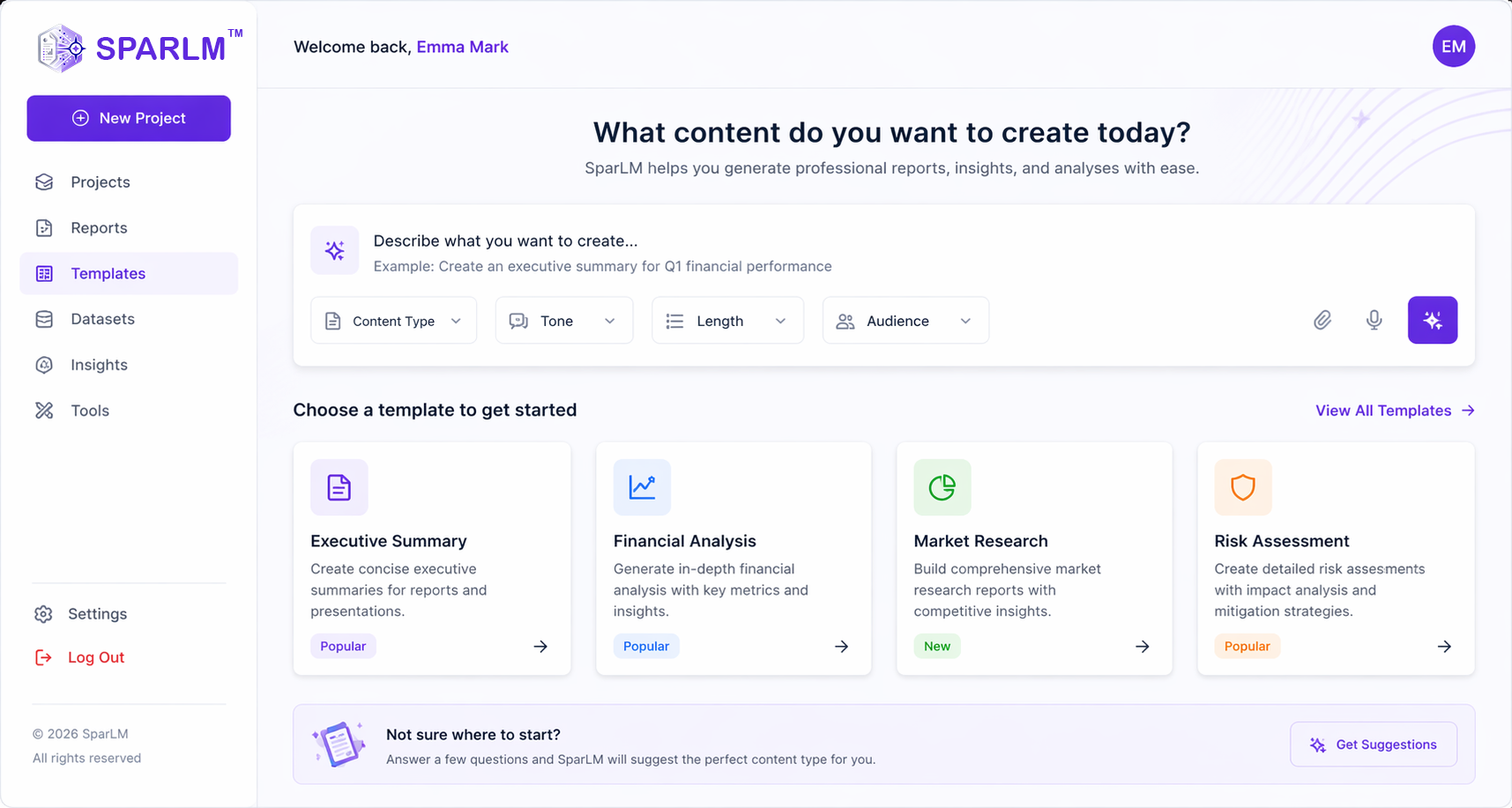
SparLM™ is not just another AI summarizer. It is an AI analyst assistant built to help professionals move from raw documents to decision-ready intelligence. It helps analysts interpret complex content, identify inconsistencies, surface insights, test assumptions, and generate structured reports that leaders can use.
Why Summaries Are Not Enough
Most AI tools can summarize a document. That is useful, but it is not enough.
A summary tells you what the document says. Analysis tells you what it means.
For analyst teams, this difference matters. A summary may reduce reading time, but it does not automatically answer deeper questions such as:
What is the key implication?
What changed from the previous version?
Which assumptions are weak?
Where are the contradictions?
What evidence supports the conclusion?
What risks should leadership care about?
What decision should this inform?
A document summary is only the starting point. Decision-ready intelligence requires reasoning, structure, evidence, comparison, and judgment.
Analysts do not need AI that only compresses documents. They need AI that helps them think through documents.
That is where SparLM™ creates value.
Where Traditional AI Tools Fail Analysts
Traditional AI tools can help with basic reading and writing tasks, but they often fall short in real analyst workflows.
They Struggle to Compare Multiple Documents
Analysts rarely work with one document in isolation. They compare quarterly reports, board decks, interview transcripts, policy documents, research papers, due diligence files, market reports, clinical summaries, meeting notes, and competitor updates using advanced document analysis AI tools like SparLM™.
A single-document summary does not solve multi-document reasoning. Analysts need to understand what is consistent, what has changed, what conflicts, and what patterns emerge across sources to create accurate, decision-ready reports.
They Miss Inconsistencies
A document may say one thing in the executive summary and something different in the appendix. A company filing may highlight growth while footnotes reveal margin pressure. A clinical report may show promising outcomes while safety data introduces caution. A strategy deck may present an opportunity while market data raises doubts.
Traditional summarization tools often miss these contradictions because they are optimized to condense content, not challenge it.
They Do Not Identify Missing Assumptions
Analyst work depends on assumptions. Market size assumptions. Revenue assumptions. Adoption assumptions. Regulatory assumptions. Risk assumptions. Operational assumptions.
Many AI tools repeat what is present in the document but do not identify what is missing. This creates a major gap because weak decisions often come from unstated or untested assumptions.
They Do Not Challenge User Logic
Most AI tools are agreeable. They answer prompts, generate text, and follow instructions. But analysts often need a sparring partner, not just an assistant.
They need a system that can ask:
Why do you believe this conclusion follows from the evidence?
What alternative explanation could exist?
Which assumption is most fragile?
What evidence would weaken this argument?
What risk has not been considered?
This kind of reasoning support improves analytical quality.
They Struggle to Generate Leadership-Ready Reports
A rough AI output is not the same as a decision-ready report. Analysts still need to clean the structure, verify evidence, rewrite for executives, remove noise, sharpen recommendations, and create a clear narrative.
SparLM™ is built to reduce that gap between document analysis and leadership communication.
They Lack Traceability
SparLM™ is designed for analysts and decision teams that work with complex enterprise documents.
It is not a chatbot.
It is not just a summarizer.
It is not a generic writing assistant.
SparLM™ is an AI reasoning assistant built to support analytical workflows from document ingestion to decision-ready reporting.
Its purpose is simple: help analysts spend less time processing information and more time improving the quality of decisions.
SparLM™ can read messy enterprise documents, interpret key themes, compare evidence, detect inconsistencies, challenge assumptions, and generate structured outputs for business use.
For analysts, this means faster document review, sharper insights, stronger reasoning, and better report generation.
The New Analyst Workflow with SparLM™
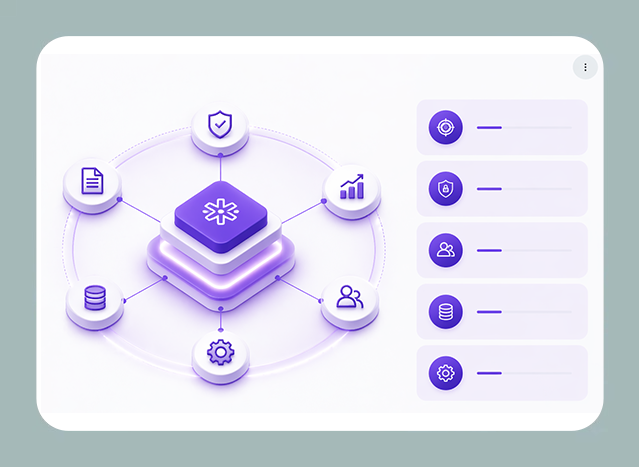
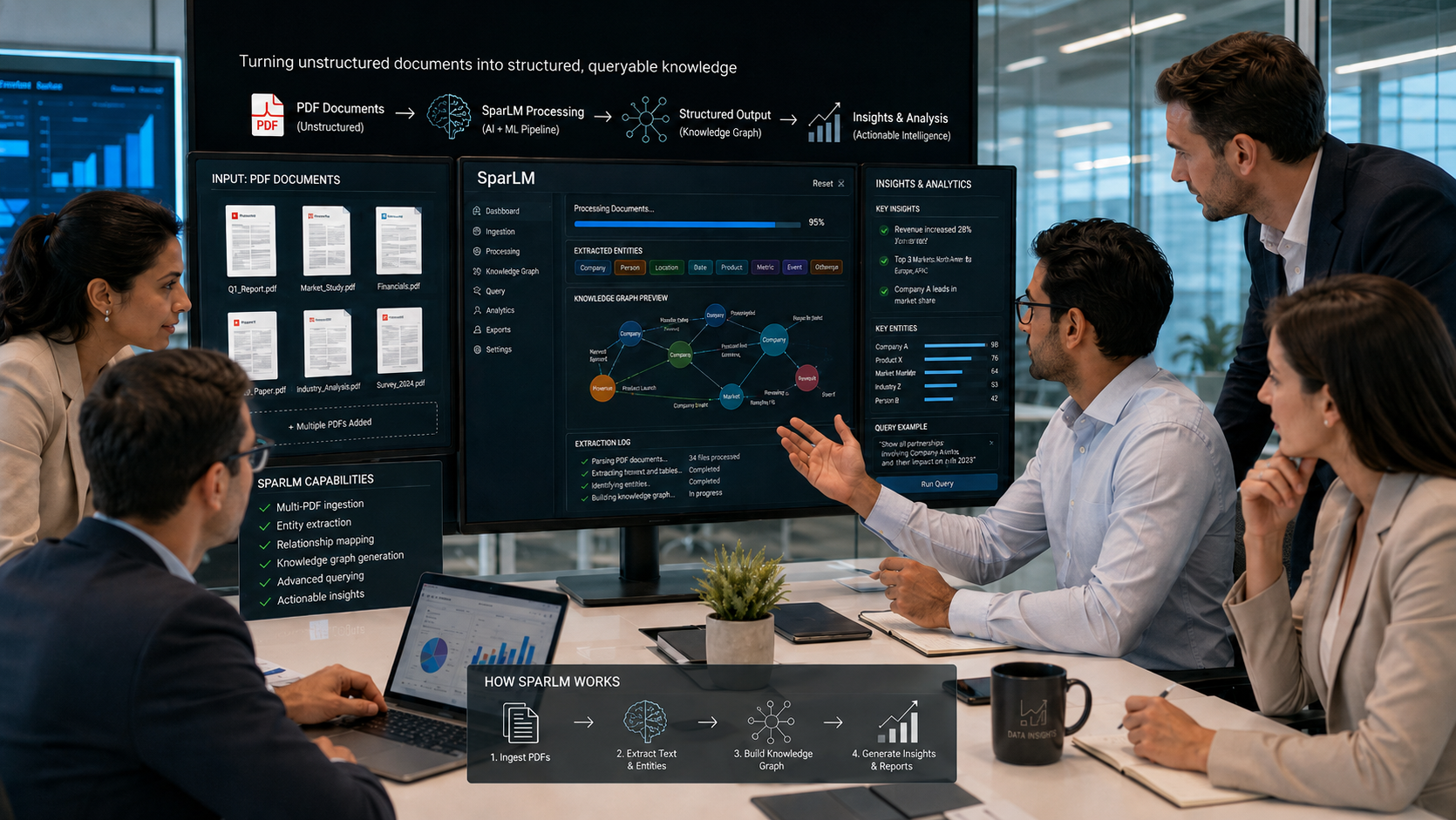
SparLM™ changes the analyst workflow by moving the process from manual reading and repetitive summarization to guided reasoning and decision-ready output creation.
Step 1: Upload Documents
The workflow begins with documents.
Analysts can bring together the materials they already work with every day, including:
PDFs
Word files
PowerPoint decks
Transcripts
Meeting notes
Research documents
Regulatory filings
Market reports
Strategy documents
Clinical summaries
Financial reports
Internal knowledge files
Instead of reading each file separately and manually extracting relevant information, analysts can use SparLM™ to create a unified analytical workspace.
This matters because real enterprise decisions are rarely based on one document. They are based on scattered evidence across multiple sources.
Step 2: SparLM™ Interprets the Content
Once documents are uploaded, SparLM™ begins interpreting the content.
It does more than summarize. It identifies:
Key drivers
Core themes
Important risks
Hidden patterns
Missing information
Contradictions
Evidence gaps
Decision-relevant signals
Repeated claims
Changes across documents
Unclear assumptions
For an analyst, this creates immediate leverage. Instead of spending hours just locating important information, the analyst can start with a structured understanding of what matters.
SparLM™ helps answer questions such as:
What are the major themes across these documents?
What risks appear repeatedly?
What has changed from one document to another?
Where does the evidence
Where does the evidence create doubt?
What information is missing for a confident decision?
This moves the workflow from document reading to insight discovery.
Step 3: Spar with the AI
The word “Spar” in SparLM™ matters.
SparLM™ is designed to help analysts test their thinking. It can challenge assumptions, question logic, identify blind spots, and reveal alternative interpretations.
This is especially valuable because analysts are often under pressure to deliver quick conclusions. Under deadline pressure, it is easy to accept the first plausible answer. SparLM™ helps slow down the reasoning where it matters most.
This Socratic sparring can include:
Questioning unsupported assumptions
Testing whether evidence supports the conclusion
Highlighting alternative explanations
Identifying weak logic
Surfacing counterarguments
Asking what could change the recommendation
Pointing out missing evidence
Reframing the problem from another stakeholder’s view
For example, if an analyst concludes that a market is attractive, SparLM may ask whether the growth is profitable, whether adoption barriers have been considered, whether competitors are already saturated, or whether the data is based on outdated assumptions.
This makes SparLM more than a productivity tool. It becomes a thinking partner.
Step 4: Generate Decision-Ready Reports
After analysis and sparring, SparLM™ helps generate structured reports that are ready for review, refinement, and leadership use.
Outputs may include:
Investment memos
Clinical summaries
Market research briefs
Risk reports
Executive summaries
Compliance notes
Due diligence reports
Strategy briefs
Portfolio reviews
Meeting summaries
Technical documentation
Regulatory briefs
Client-ready reports
The goal is not to remove the analyst from the process. The goal is to reduce repetitive drafting and give analysts a stronger first version.
SparLM™ helps transform scattered documents into structured, evidence-backed outputs that analysts can review, improve, and deliver faster.
What Makes SparLM™ Technically Different
SparLM™ is built around the needs of enterprise analysts who work with messy documents, incomplete information, and high-pressure decisions.
Input Layer for Messy Enterprise Documents
Enterprise documents are rarely clean. They include long PDFs, scanned formats, dense tables, slide decks, transcripts, formatting inconsistencies, footnotes, charts, appendices, and mixed content types.
SparLM™ is designed to handle this messy input environment so analysts can work with real business materials, not only perfectly structured files.
Semantic Processing
SparLM™ focuses on meaning, not just keywords, making it a powerful AI analyst assistant for enterprise research and decision-making.
Semantic processing helps the system understand relationships between ideas, themes, risks, claims, and supporting evidence. This allows analysts to ask higher-quality questions and receive more useful responses through advanced document analysis AI capabilities.
Instead of only finding exact text matches, SparLM™ can help identify conceptually related information across documents and support faster AI report generation with deeper contextual understanding.
Recursive Chunking
Long documents create challenges for AI systems because important context may be spread across sections, pages, tables, and appendices.
SparLM™ uses structured document processing approaches such as recursive chunking to preserve context while breaking documents into manageable analytical units.
This supports deeper analysis across long-form enterprise material.
Multi-Document Reasoning
Analysts often need to compare multiple sources at once. SparLM™ supports multi-document reasoning by connecting insights across uploaded materials.
This helps analysts identify patterns, differences, contradictions, and evidence relationships that may not be visible when documents are reviewed one by one.
Contradiction Detection
One of SparLM™ most valuable capabilities is helping analysts detect inconsistencies.
These may include:
Conflicting numbers
Different assumptions across documents
Misaligned claims
Policy inconsistencies
Contradictory risk statements
Differences between narrative and data
Changes between document versions
Mismatch between strategy and evidence
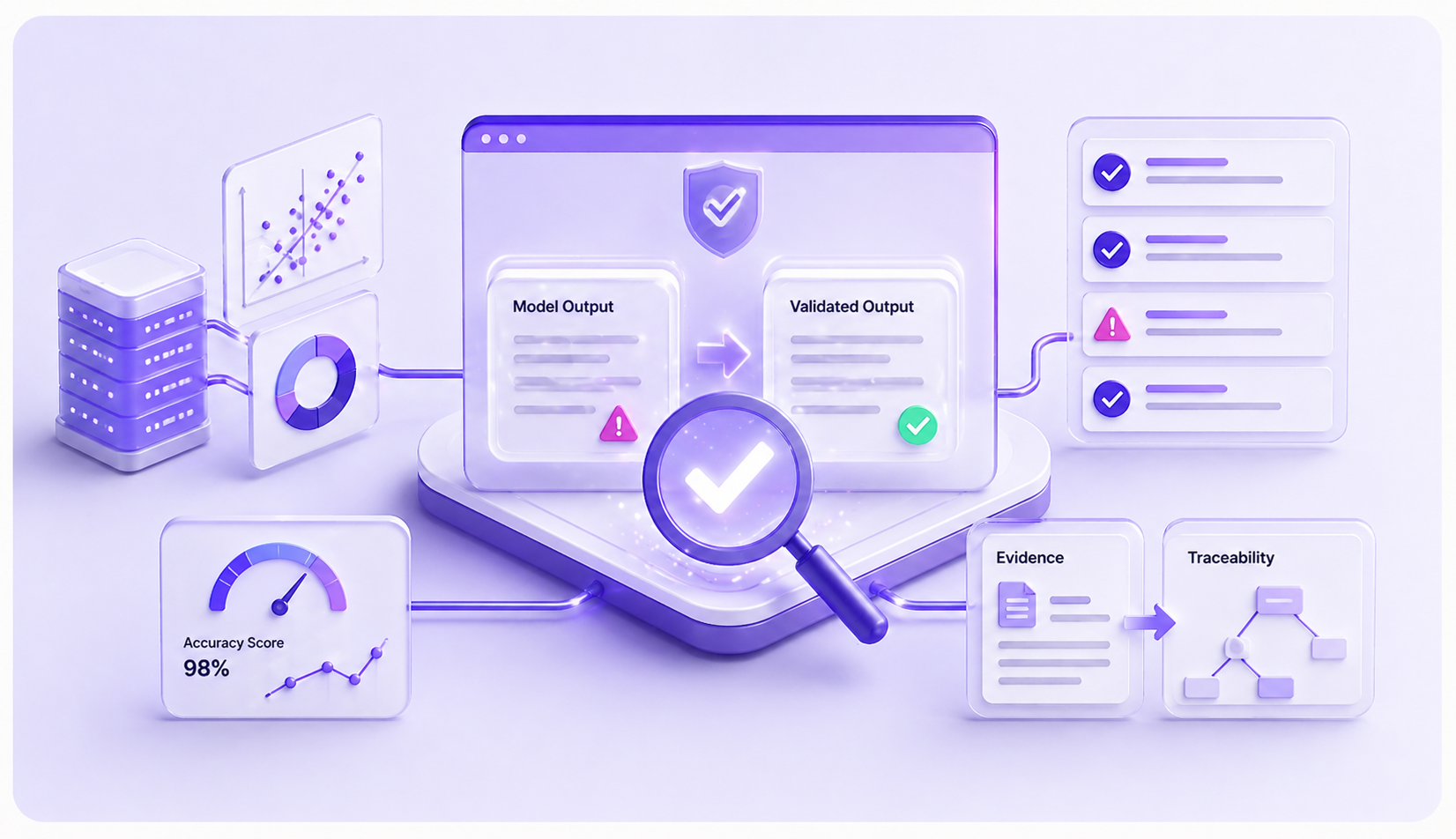
Evidence-Backed Report Generation
SparLM™ helps generate reports grounded in source material. This improves trust because analysts can connect conclusions to the documents behind them.
Evidence-backed report generation supports better review, faster validation, and stronger leadership confidence.
Reasoning Traceability
Traceability is critical for enterprise analyst workflows. SparLM™ is designed to support reasoning traceability so teams can understand how an insight was developed and what evidence informed the output.
This matters for investment teams, consulting teams, pharma teams, compliance teams, and strategy teams where decisions must be defensible.
Impact Across Industries
SparLM™is useful wherever analysts work with large volumes of documents and need to produce decision-ready outputs.
Finance: Investment Memos, Portfolio Reviews, and Due Diligence Notes
Finance teams work with earnings reports, market research, investor presentations, filings, portfolio data, diligence documents, and transaction materials.
SparLM™ can help finance analysts:
Summarize company filings
Compare investment opportunities
Identify risks across documents
Generate investment memos
Review portfolio updates
Detect inconsistencies in assumptions
Prepare due diligence notes
Create executive-ready financial briefs
For investment teams, speed matters. But confidence matters more. SparLM™ helps improve both by reducing manual review time while strengthening evidence-based reasoning.
Pharma: Clinical Summaries, Safety Reports, and Regulatory Briefs
Pharma teams work with clinical study documents, safety data, regulatory submissions, medical literature, trial updates, and internal research reports.
SparLM™ can help pharma analysts:
Summarize clinical study reports
Compare trial findings
Identify safety signals
Prepare regulatory briefs
Extract key endpoints
Review study assumptions
Generate medical research summaries
Support evidence synthesis
In pharma, the challenge is not only volume. It is complexity. SparLM™ helps teams navigate dense documentation and produce structured outputs for expert review.
IT and SDLC: Requirements, QA Documentation, and Meeting Summaries
IT and software delivery teams manage requirements documents, user stories, design notes, technical specifications, QA documentation, release notes, architecture documents, and meeting transcripts.
SparLM™ can help IT and SDLC teams:
Convert requirements into technical summaries
Identify gaps in user stories
Summarize sprint discussions
Generate QA documentation
Compare business requirements with technical specifications
Highlight unclear acceptance criteria
Produce meeting summaries
Create implementation briefs
This helps teams reduce ambiguity and improve alignment between business, product, engineering, and QA stakeholders.
Consulting: Market Landscapes, Strategy Briefs, and Client-Ready Reports
Consultants work with large volumes of research, interviews, client documents, market reports, competitor analysis, and internal frameworks.
SparLM™ can help consulting teams:
Build market landscape summaries
Compare competitor strategies
Analyze interview transcripts
Generate strategy briefs
Identify client risks
Prepare client-ready reports
Create executive summaries
Challenge recommendation logic
For consulting teams, SparLM™ can reduce the time spent turning research into structured deliverables while improving the quality of reasoning behind recommendations.
Research and Strategy Teams: Insight Discovery and Decision Support
Research and strategy teams need to synthesize information from many sources and turn it into action.
SparLM™ can help these teams:
Identify emerging themes
Compare strategic options
Detect gaps in evidence
Build leadership briefs
Challenge assumptions
Generate decision memos
Map risks and opportunities
Create structured recommendations
This makes SparLM™ especially useful for teams that need to connect research with enterprise action.
Before vs. After SparLM™
SparLM™ changes the analyst workflow by improving speed, quality, and confidence.
Reading Time: From Hours to Minutes
Before SparLM™, analysts may spend hours reading documents just to understand the basic structure and key points.
After SparLM™, they can quickly identify themes, risks, important sections, and decision-relevant signals.
Contradiction Checks: From Manual to Built-In
Before SparLM™, analysts manually compare documents, tables, claims, and assumptions to find inconsistencies.
After SparLM™, contradiction detection becomes part of the workflow, helping analysts identify mismatches earlier.
Report Writing: From Repetitive to Automated
Before SparLM™, analysts spend significant time drafting summaries, memos, briefs, and report sections from scratch.
AfterSparLM™, they can generate structured first drafts and focus on refinement, judgment, and final recommendations.
Review Cycles: From Multiple Edits to Faster Refinement
Before SparLM™, reports may go through repeated review cycles because assumptions, evidence, or structure are unclear.
After SparLM™, analysts can produce more organized, evidence-backed outputs that are easier to review.
Decision Confidence: Improved Through Traceable Evidence
Before SparLM™, leadership may question where insights came from or whether the analysis fully considered the available evidence.
After SparLM™, analysts can present outputs with stronger traceability, clearer reasoning, and better support for decisions.
SparLM™ as an AI Analyst Assistant
The best way to understand SparLM™ is not as a replacement for analysts, but as an AI analyst assistant.
It handles repetitive, time-consuming, and document-heavy tasks so analysts can focus on higher-value work.
SparLM™ supports:
Document analysis
AI report generation
Analyst workflow automation
Multi-document comparison
Assumption testing
Contradiction detection
Insight discovery
Decision-ready reports
This allows analysts to spend more time asking better questions, interpreting evidence, and advising decision-makers.
Why SparLM™ Matters for Managers and Decision Teams
SparLM™ does not only help individual analysts. It also helps managers and decision teams.
Managers need faster access to structured insights. They need confidence that reports are grounded in evidence. They need to reduce review cycles. They need teams to focus on judgment rather than formatting.
SparLM™ supports this by improving the quality and consistency of analyst outputs.
For decision teams, the value is clear:
Faster briefing cycles
Better evidence visibility
Improved analytical consistency
Reduced manual processing
Stronger review quality
More structured decision support
In fast-moving enterprise environments, this can make the difference between delayed reporting and timely action.
Why SparLM™ Is More Than AI Report Generation
AI report generation is useful, but SparLM™ goes further.
A basic AI writing tool can draft text. SparLM™ is designed to support the analytical process before the draft is created.
It helps analysts understand the documents, test reasoning, detect issues, and structure the output.
This matters because a report is only as strong as the thinking behind it.
SparLM™ improves the workflow from input to insight to decision.
How SparLM™ Helps Analysts Think Better
SparLM™ improves analyst work in three important ways.
First, it reduces cognitive overload. Analysts do not have to hold every document, section, table, and claim in memory at once.
Second, it improves reasoning quality. SparLM™ can challenge assumptions, identify gaps, and surface contradictions that may otherwise be missed.
Third, it accelerates communication. SparLM™ helps turn analysis into structured outputs that decision-makers can understand and use.
This combination makes SparLM™ valuable not just for productivity, but for decision quality.
AI as a Thinking Partner, Not Just a Writing Tool
The next phase of enterprise AI is not about generating more text. It is about improving how teams think, analyze, decide, and act.
For analysts, this distinction is critical.
A writing tool helps produce words.
A summarizer helps shorten documents.
A chatbot helps answer questions.
A reasoning assistant helps improve decisions.
SparLM™ is built around that final category.
It helps analysts move from document overload to structured intelligence. It helps teams reduce grunt work while improving analytical rigor. It helps managers receive clearer, stronger, and more evidence-backed reports.
Most importantly, SparLM™ augments analysts rather than replacing them.
The analyst remains responsible for judgment, context, expertise, and final recommendations.SparLM™ strengthens the process by improving speed, structure, and reasoning support.
Conclusion: From Documents to Decisions
Analysts are not short on information. They are overwhelmed by it.
Long PDFs, strategy decks, transcripts, research reports, regulatory filings, meeting notes, and internal documents continue to grow in volume and complexity. The challenge is no longer access to information. The challenge is turning that information into decisions with effective document analysis AI.
SparLM™ helps solve that challenge.
This AI analyst assistant enables analysts to move beyond summaries and into decision-ready intelligence. It helps detect inconsistencies, surface insights, challenge assumptions, generate structured reports, and improve analyst workflow automation.
For finance teams, pharma teams, consulting teams, IT teams, research teams, and strategy teams, SparLM™ offers a better way to work.
The future of analyst productivity is not just faster reading. It is better reasoning.
And that is where SparLM™ changes the workflow.
Call to Action
Turn documents into decision-ready reports. Explore SparLM™ by TekFrameworks and see how an AI analyst assistant can help your teams analyze faster, reason better, and deliver stronger insights.
FAQs
What is SparLM™?
SparLM™ is an AI analyst assistant by TekFrameworks that helps analysts review complex documents, identify insights, detect inconsistencies, challenge assumptions, and generate decision-ready reports.
How is SparLM™ different from a regular AI summarizer?
A regular AI summarizer condenses content. SparLM™ supports analytical reasoning by interpreting documents, comparing information, surfacing risks, identifying contradictions, testing assumptions, and generating structured outputs.
Who can use SparLM™?
SparLM™ is designed for analysts, managers, investment teams, consulting teams, pharma teams, research teams, strategy teams, and enterprise decision teams that work with large volumes of documents.
What types of documents can SparLM™ analyze?
SparLM™ can support workflows involving PDFs, Word files, PowerPoint decks, transcripts, meeting notes, research documents, regulatory filings, strategy documents, clinical summaries, and financial reports.
Can SparLM™ help generate reports?
Yes. SparLM™ can help generate investment memos, market research briefs, clinical summaries, risk reports, executive summaries, compliance notes, due diligence notes, and other decisionready reports.
Does SparLM™ replace analysts?
No. SparLM™ augments analysts. It reduces repetitive document-processing work and supports better reasoning, but analysts remain responsible for judgment, review, context, and final recommendations.
Why is traceability important in AI report generation?
Traceability helps analysts and decision-makers understand where insights came from and what evidence supports them. This improves trust, review quality, and decision confidence.
How does SparLM™ improve analyst workflow automation?
SparLM™ automates time-consuming parts of the analyst workflow, including document interpretation, theme extraction, contradiction detection, assumption testing, and first-draft report generation.