









An Inline Distributed Cognitive Fabric for the Enterprise
Cortexa unifies and orchestrates specialized intelligence inside a governed harness for enterprise reasoning, governance, memory, observability, and model-agnostic AI execution. It helps teams understand what is happening, control risk, estimate cost, and make better AI decisions.



The Problem Cortexa Solves
Most organizations cannot see
 inside their AI operations.
Enterprises are deploying copilots, chatbots, RAG systems, and agentic workflows faster than they can govern, explain, or cost-manage them. Cortexa becomes the inline harness around enterprise AI execution.
Strategy-First AI Advisory
Define AI’s role in enterprise strategy, evaluate Build vs Buy vs Hybrid paths, and turn fragmented pilots


Ask Any Things ..


Search

Create Image



AI cost is difficult to predict
Token usage, model selection, long context windows, repeated retries, agent loops, and unnecessary model calls make AI costs unpredictable.


Decision logic is opaque
Many AI workflows produce outputs, but organizations cannot clearly explain how the answer was created, reviewed, or accepted.


Governance is outside the flow
AI policies often sit in documents while execution happens elsewhere. Cortexa brings governance directly into the AI request path.


How Cortexa Works Inline
Built to wrap, govern, and improve enterprise AI workflows.

Enterprise apps
Cortexa works with CRM, ERP, HRIS, internal portals, workflow systems, document systems, and custom enterprise applications. It helps ensure AI requests are governed, routed, monitored, and recorded.
01


Agents & Agentic systems
Cortexa works with workflows where AI systems plan, call tools, retrieve data, make decisions, and perform multi-step tasks. It helps control tool usage, retry loops, approval checkpoints, risk boundaries, state, cost escalation, and decision lineage.
02

Chatbots & Copilots
Cortexa can wrap existing assistants to add governance, evidence tracking, cost visibility, quality scoring, and auditability. This is useful when organizations already have AI assistants but cannot fully see what they are doing.
03

Any model
Cortexa is model-agnostic. It can work with GPT, Claude, Gemini, open-source models, domain-specific SLMs, on-prem models, cloud models, and private enterprise models.
04



 Specialized Intelligence
Cortexa is not only a gateway.
A simple AI gateway can route model calls. Cortexa goes further by providing specialized intelligence for understanding, governing, orchestrating, evaluating, and improving AI workflows.

Step 1
Classify intent
Understand whether the task requires search, retrieval, reasoning, compliance review, calculation, report generation, tool execution, or approval.

Step 2
Apply governance
Check tenant policies, role permissions, data access, PII, regulatory constraints, model rules, guardrails, and approval requirements.

Step 3
Select execution path
Route to retrieval, planner, challenger, composer, domain SLM, external LLM, tools, fallback, or human approval.
Step 4
Measure quality
Evaluate groundedness, completeness, evidence quality, contradictions, confidence, compliance, usefulness, citation strength, and risk.
Step 5
Write back learning
Store decision records, evidence trails, feedback, output scores, cost patterns, drift signals, workflow performance, and improvement signals.


Transparent Tokenomics
AI costs should not be a surprise.

Token usage
Track input tokens, output tokens, context tokens, retrieval size, and total token consumption.



Budget decisions
Help leadership identify high-cost, low-value workflows and prioritize optimization opportunities.

Cost attribution
Allocate AI cost by tenant, project, department, user, workflow, application, model, purpose, and use case.

Model usage
See which models are used by which workflow, department, project, tenant, or user group.

Model routing economics
Compare when to use a premium LLM, smaller LLM, domain SLM, open-source model, retrieval-only flow, tool-based execution, or human-in-the-loop flow.
Quality-cost tradeoff
Understand whether higher model cost, larger context, or agent loops are producing better outcomes or simply increasing spend
Regulated AI Readiness
Help leaders answer the questions regulators, auditors, and boards will ask.
As AI becomes part of business operations, organizations need to explain who used the system, what the purpose was, what data was used, whether sensitive data was protected, which model was selected, whether the response was grounded, whether policy was applied, whether human approval was required, what the workflow cost, and whether the final outcome was accepted or corrected.



Architecture Overview
Inline control, governed execution, and full observability.
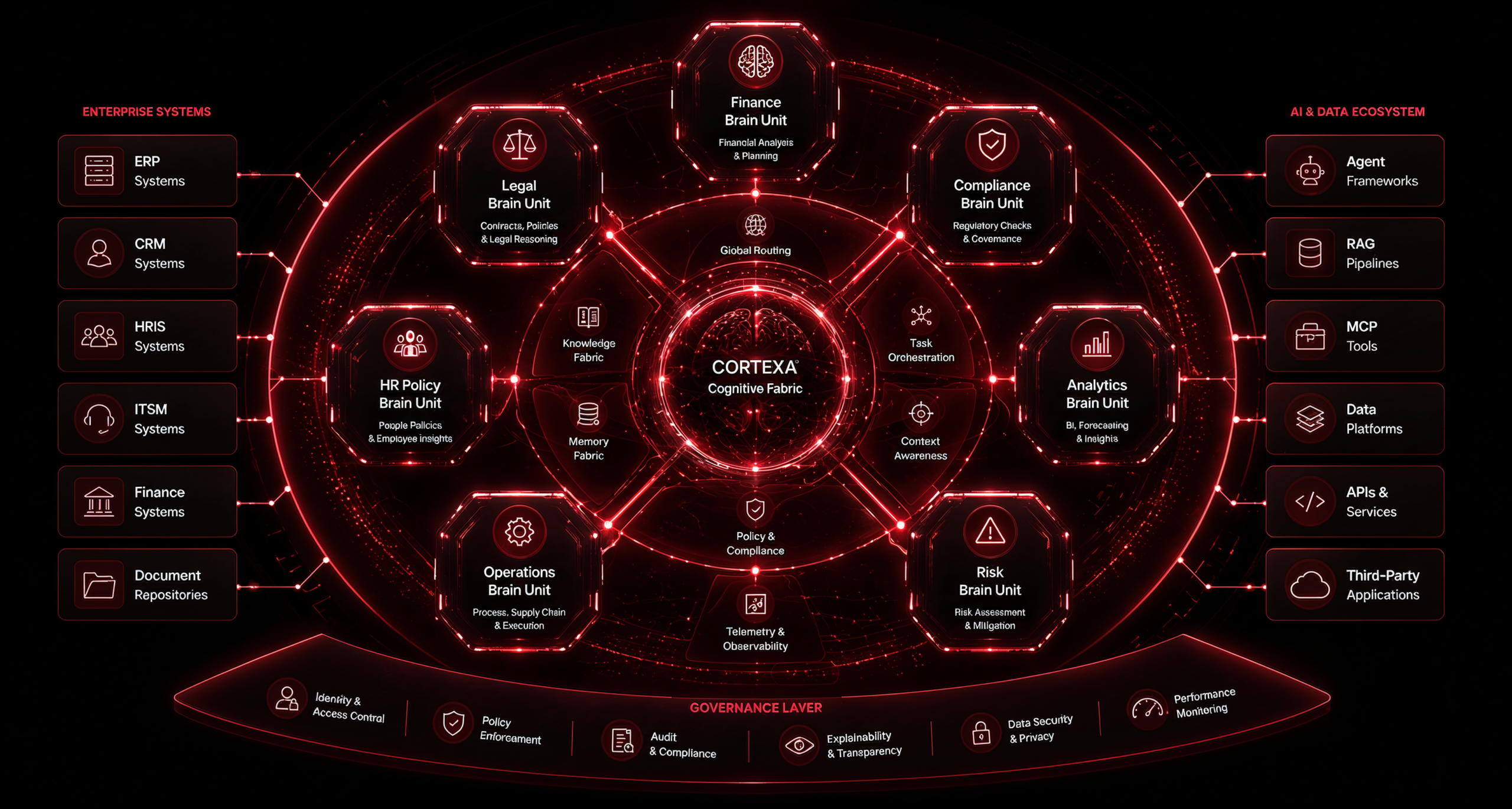
Cortexa brings together five major capabilities across connection, governance, reasoning, memory, lineage, telemetry, and tokenomics.

Cortexa Nexus
Enterprise connection fabric for apps, documents, APIs, data stores, events, agentic systems, chatbots, and external tools.

Cortexa Govern
Policy, trust, intent control, guardrails, PII controls, approval gates, governed context, tenant policies, and risk boundaries.

Cortexa Core
Cognitive reasoning and orchestration for intent dispatch, state management, planning, challenger checks, composition, and assurance.

Cortexa Fabric
Enterprise memory and lineage through decision ledger, knowledge graph, semantic cache, feedback store, evidence records, and retrieval index.

Cortexa Signal
Cognitive telemetry and observability for tracing, cost attribution, quality scoring, drift detection, evaluation, dashboards, and tokenomics.

Recommended Pilot Areas
Start where visibility, governance,
 and cost matter most.
1
AI Chatbot Governance
Common user intents , Responses requiring governance, Models being used, Token cost, , Low-confidence outputs , Hallucination risk , Human review needs
2
Agentic Workflow Control
Tool usage , Approval gates , Retry limits , Context boundaries , Sensitive data exposure , Cost escalation , Decision records
3
Enterprise RAG Observability
Retrieval quality , Citation quality , Context relevance , Answer groundedness , Token consumption , Latency , Quality-cost tradeoff
4
AI Cost and Tokenomics Control
Cost by model , Cost by workflow , Cost by department , Cost by project , Cost by user group , Cost by request type , Cost versus quality score



Enterprise Outcomes
Better control, stronger visibility, and faster AI scale-up.
Smarter decisions
Understand not only the AI output, but also the evidence, context, cost, and governance behind it.
Better AI governance
Apply policy directly into execution rather than leaving governance outside the workflow.
Reduced AI risk
Detect sensitive data exposure, weak grounding, risky outputs, approval needs, and uncontrolled agent behavior.
Cost visibility
Make AI cost measurable by tokens, models, workflows, users, tenants, and business purpose.
Model flexibility
Use multiple models and select the right model for the right task without lock-in.

Faster AI scale-up
Move from isolated AI pilots to controlled, observable, and reusable AI operations.
 Who Cortexa Is For
Designed for organizations adopting AI at enterprise scale.
Cortexa is best suited for organizations that need better control, visibility, accountability, and cost transparency across AI workflows.


Where Cortexa Fits
A control
 intelligence layer for enterprise AI operations.
AI governance harness
Bring policy, guardrails, approvals, and risk controls directly into AI execution.
AI observability layer
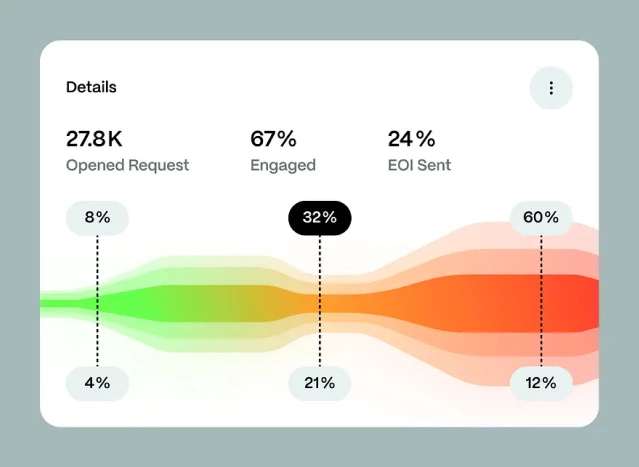
Track requests, context, model calls, tokens, latency, quality, cost, and outcomes.
Agentic workflow control
Control tool usage, retries, state, approvals, escalation, and execution boundaries.
Model routing and optimization
Select the right model, tool, or workflow path based on intent, complexity, risk, and cost.
Decision lineage layer
Preserve context, evidence, model selection, reasoning path, review actions, and final outcomes.
RAG quality and grounding
Monitor retrieval quality, citation strength, groundedness, hallucination risk, and context relevance.