



May 19, 2026
The Enterprise AI Scalability Crisis
Most enterprises began their AI journey with practical experiments. They launched chatbots, tested Retrieval-Augmented Generation systems, connected general-purpose large language models to enterprise documents, and built internal copilots for employees.
These initiatives were useful. They helped teams understand what generative AI could do. They improved access to information, accelerated document search, and made enterprise knowledge easier to query.
But many organizations are now discovering a difficult truth: chatbots, RAG systems, and generic LLMs do not automatically create scalable enterprise intelligence.
They may answer questions. They may summarize documents. They may retrieve policies, contracts, reports, or knowledge-base articles. But enterprise decision-making requires more than retrieval and language generation.
It requires reasoning, memory, accountability, governance, role alignment, auditability, and operational control.
This is where the enterprise AI conversation must evolve. The problem is not only an AI model problem. It is a reasoning architecture problem.
Enterprises do not simply need bigger models. They need enterprise cognitive architecture: a governed intelligence layer that can structure reasoning, connect domain-specific capabilities, preserve decision context, and support accountable AI-driven action.
The Limits of “One LLM for Everything”
Generic LLMs are powerful, flexible, and impressive. They can generate content, answer questions, write code, summarize documents, and assist with analysis. But using one generalpurpose LLM as the intelligence layer for the entire enterprise creates significant limitations.
Centralized Inference Bottleneck
When every enterprise AI use case depends on a single large model, the system can become slow, expensive, and operationally fragile.
Different business functions have different needs. Finance may require numerical accuracy and audit trails. Legal may require clause-level reasoning. HR may require policy interpretation. Compliance may require regulatory mapping. Operations may require workflow-specific recommendations.
A single generic model may support many of these tasks at a surface level, but it is not designed to operate as a specialist decision system for every enterprise domain.
High Token Costs
Large language models can become expensive when they are used for every interaction, every query, every workflow, and every decision-support process.
The more context an enterprise adds, the more tokens the model consumes. As AI adoption expands across teams, costs can rise quickly. This becomes especially challenging when enterprises use large models for tasks that could be handled by smaller, domain-specific, or purpose-built intelligence components.
A scalable AI decision architecture should use the right intelligence layer for the right task, not the largest model for every task.
Domain Confusion
Generic LLMs are trained to be broad. Enterprises need intelligence that is specific.
A general-purpose model may understand common business language, but it may not fully understand how a specific enterprise defines risk, revenue, customer segments, approval workflows, exception handling, contractual obligations, product policies, or regulatory responsibilities.
This creates domain confusion. The model may generate a plausible answer, but not necessarily the correct answer for that organization, that function, that jurisdiction, or that decision context.
No Enterprise Ownership
When intelligence sits primarily inside an external model, the enterprise does not fully own the reasoning layer.
The organization may own its documents, workflows, and data. But if the reasoning process depends on a generic model that is not aligned with enterprise roles, controls, memory, and governance, decision ownership becomes unclear.
For regulated or complex enterprises, this is not a small issue. Leaders need to know who owns the decision logic, who approves it, who monitors it, and who is accountable when it influences business outcomes.
Single Point of Failure
A single-model strategy creates concentration risk. If the model fails, changes behavior, produces inconsistent outputs, becomes unavailable, or does not meet compliance expectations, many enterprise use cases may be affected at once.
A more resilient approach distributes intelligence across domain-specific components, governance layers, monitoring systems, and controlled orchestration.
Vendor-Controlled Intelligence
Enterprises must also consider strategic dependency. When most AI capability is outsourced to generic external models, organizations may become dependent on vendor-defined capabilities, pricing, policies, and model behavior.
This does not mean enterprises should avoid external LLMs. It means they should avoid making generic models the only foundation of enterprise intelligence.
Why RAG Is Useful - But Not a Brain
Retrieval-Augmented Generation, or RAG, is one of the most common enterprise AI patterns. It connects an LLM to external knowledge sources so the model can retrieve relevant context before generating a response.
This is valuable. RAG can improve document Q&A, reduce unsupported responses, and help employees access enterprise knowledge faster. Research and industry guidance consistently show that RAG can reduce hallucinations and improve contextual relevance when retrieval quality is strong.
But RAG is not the same as enterprise reasoning.
RAG Retrieves Context
RAG helps the model find relevant information from documents, databases, knowledge bases, or indexed repositories. This makes it useful for answering questions such as:
What does this policy say?
Where is this clause mentioned?
What are the latest process guidelines?
Which document contains this requirement?
How does this report describe performance?
These are important knowledge-access use cases.
RAG Improves Chatbots and Document Q&A
RAG is especially effective when the problem is information retrieval. It can help employees query manuals, SOPs, contracts, product documentation, FAQs, internal wikis, research reports, and compliance documents.
This makes RAG a strong foundation for enterprise search, knowledge assistants, and support copilots.
RAG Does Not Create Specialist Reasoning
Retrieval is not reasoning.
A RAG system can retrieve a policy, but it may not understand how that policy interacts with role authority, exception handling, jurisdiction, risk tier, past decisions, business rules, and approval workflows.
It can pull context, but it does not automatically know how to make a governed enterprise decision.
RAG Does Not Provide Persistent Enterprise Memory
Most RAG systems retrieve from indexed content, but they do not automatically maintain structured memory of past decisions, rationales, escalations, approvals, exceptions, and outcomes.
Enterprise decision-making depends on memory. Leaders need to know what was decided, why it was decided, who approved it, what evidence was used, and whether the outcome changed over time.
A document-retrieval layer alone does not solve that.
RAG Does Not Solve Decision Accountability
RAG may provide an answer, but enterprise leaders still need accountability.
Who owns the output?
Who validates the recommendation?
Who decides whether the AI can act?
Who approves exceptions?
Who monitors performance?
Who is responsible if the answer creates business risk?
These are architecture and governance questions, not retrieval questions.
RAG Does Not Create Governed Intelligence
RAG can help ground responses in enterprise content, but governance requires more. NIST’s AI Risk Management Framework highlights the need to incorporate trustworthiness considerations into the design, development, use, and evaluation of AI systems.
For enterprise AI, this means governance cannot be limited to better prompts or better retrieval. It must be embedded into the architecture.
The Five Walls Enterprises Hit with AI
As enterprises move beyond pilots, they often hit five major walls. These walls explain why RAG and generic LLMs alone cannot carry enterprise decision-making at scale.
1. The Architectural Wall
The first wall is architectural.
Many enterprise AI systems are built as isolated applications. One team builds a chatbot. Another creates a document Q&A tool. Another connects an LLM to a workflow. Another experiments with agents. Each project may work independently, but the enterprise lacks a unified intelligence architecture.
This creates fragmentation. Knowledge is duplicated. Governance is inconsistent. Tools do not share memory. Decision logic is not reusable. Monitoring is scattered.
To scale AI, enterprises need a structured architecture where specialized intelligence components can coordinate safely.
2. The Economic Wall
The second wall is economic.
Using generic LLMs for every task can become costly. High token consumption, repeated context loading, large-model dependency, and duplicated AI workflows can create unsustainable economics.
Enterprises need cost-aware intelligence design. Some tasks may require advanced LLM reasoning. Others may be handled through smaller models, rule-based logic, workflow automation, knowledge graphs, domain-specific engines, or specialized Brain Units.
The goal is not to avoid LLMs. The goal is to use them intelligently within a broader cognitive architecture.
3. The Human Adoption Wall
The third wall is human adoption.
Employees may test AI tools, but they will not trust them for serious decisions unless the system is reliable, explainable, role-aware, and aligned with how work actually gets done.
A generic chatbot may feel useful for casual queries. But when a finance manager, compliance officer, HR leader, or legal reviewer needs to make a decision, they need more than a fluent answer.
They need context, confidence, evidence, approval logic, escalation paths, and accountability.
If AI does not fit into human decision workflows, adoption will remain shallow.
4. The Operational Lifecycle Wall
The fourth wall is operational lifecycle management.
Enterprise AI systems must be monitored, updated, evaluated, secured, and improved over time. Data changes. Policies change. Regulations change. Business priorities change. Model behavior may drift. Retrieval quality may decline. User needs may evolve.
An AI system that works in a demo may fail in production if lifecycle management is weak.
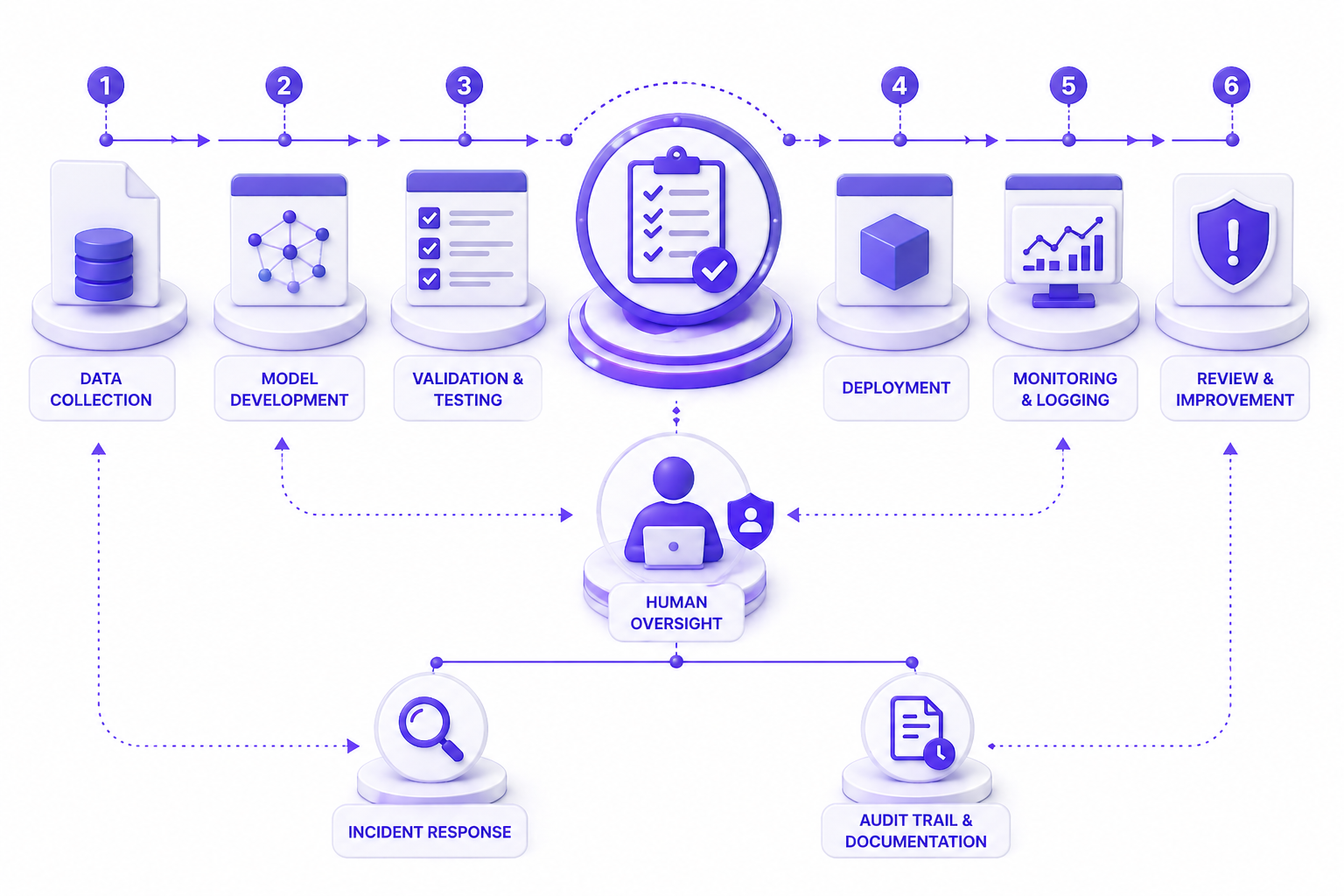
Enterprises need observability, versioning, performance monitoring, feedback loops, incident handling, and continuous evaluation.
5. The Governance and Audit Wall
The fifth wall is governance and auditability.
As AI becomes more agentic and integrated into business systems, enterprises need visibility into what AI is doing, why it is doing it, what data it accessed, what action it took, and what impact it created. Recent enterprise AI governance discussions increasingly emphasize that organizations need stronger visibility, control, and accountability as agentic systems move closer to enterprise workflows.
This is especially important in regulated industries. If an AI system supports decisions in finance, healthcare, insurance, pharma, manufacturing, or the public sector, the enterprise must be able to explain and audit its behavior.
Generic LLMs and basic RAG pipelines do not provide this by default.

The Missing Layer: Enterprise Decision Architecture
The missing layer in many AI programs is enterprise decision architecture.
Enterprise decision architecture defines how AI-supported decisions are structured, governed, routed, monitored, and owned across the organization.
It answers questions such as:
How should AI reason within a specific business domain?
Which roles can approve or override AI recommendations?
What memory should be preserved?
What evidence should be attached to a decision?
Which policies should be enforced automatically?
When should an issue escalate to a human?
How should AI actions be monitored and audited?
This is different from simply connecting an LLM to documents.
Structuring Reasoning
Enterprise reasoning must follow business logic. It must understand decision criteria, constraints, risk levels, thresholds, roles, and exceptions.
A decision architecture gives AI systems a structured way to reason within enterprise boundaries.
Aligning with Roles and Authority
Enterprise decisions are role-based. A junior employee, manager, compliance officer, legal head, business unit leader, and CXO do not have the same authority.
AI systems must understand these authority boundaries. They must know when to recommend, when to escalate, when to block, and when to request approval.
Preserving Memory
Enterprise intelligence should not forget everything after each interaction.
Decision architecture requires persistent memory of business context, past actions, approved exceptions, user feedback, policy changes, and outcome history.
This memory allows AI systems to become more useful, consistent, and aligned over time.
Governing Decisions
Governance should be embedded into the decision flow. The system should know which policies apply, which controls are required, what evidence must be captured, and when human review is mandatory.
Providing Audit and Control
Every AI-supported decision should be traceable when needed. Enterprises should be able to inspect what data was used, what reasoning path was followed, which policy was applied, who approved the action, and what outcome occurred.
That is the difference between a chatbot and an enterprise intelligence layer.
What Is a Brain Unit?
A Brain Unit is a capability-domain intelligence node.
In simple terms, it is a specialized AI component designed to understand a specific business domain, decision area, or enterprise capability.
A Brain Unit can include:
Domain knowledge
Reasoning logic
Persistent memory
Approved tools
Data access rules
Workflow awareness
Governance controls
Role-based authority
Monitoring and audit trails
A Brain Unit is not just a prompt. It is not just a chatbot. It is not just a document index.
It is a governed intelligence unit built around a business capability.
Example: Finance Brain Unit
A Finance Brain Unit may support budget analysis, variance explanations, forecasting, cost optimization, invoice exceptions, and financial policy interpretation.
It would understand finance-specific data, controls, approval workflows, reporting structures, and risk thresholds.
Example: Compliance Brain Unit
A Compliance Brain Unit may interpret policies, monitor regulatory obligations, identify control gaps, route exceptions, and support audit preparation.
It would not simply retrieve compliance documents. It would reason within approved compliance logic and escalation rules.
Example: HR Policy Brain Unit
An HR Policy Brain Unit may answer employee policy questions, support manager decisions, interpret leave rules, guide promotion workflows, and flag sensitive cases for human review.
It would understand role sensitivity, employee data boundaries, policy exceptions, and confidentiality requirements.
What Is Cognitive Fabric?
A Cognitive Fabric is the governed mesh that connects Brain Units across the enterprise.
If Brain Units are specialist intelligence nodes, Cognitive Fabric is the coordination layer.
It routes tasks, shares knowledge, enforces policies, manages permissions, monitors behavior, and creates observability across the enterprise AI ecosystem.
A Cognitive Fabric helps answer questions such as:
Which Brain Unit should handle this task?
Does this request require more than one domain?
What policy applies?
Is this user authorized?
Should the system escalate to a human?
What memory should be updated?
What audit trail should be created?
What risk level does this decision carry?
This is how enterprises move from disconnected AI tools to governed intelligence.

How Cognitive Fabric Maps to Real Enterprises
Enterprise work is already divided into functions, roles, capabilities, and decision domains. Cognitive Fabric mirrors this structure by creating specialist intelligence units that coordinate through a governed layer.
Finance Brain Unit
The Finance Brain Unit can support financial planning, reporting, variance analysis, budget controls, invoice reviews, procurement exceptions, cash-flow insights, and cost optimization.
It can work with finance systems, policies, approval matrices, and reporting frameworks.
Instead of asking a generic LLM to “analyze finance,” the enterprise gains a finance-aware intelligence node with governed access, memory, and accountability.
Compliance Brain Unit
The Compliance Brain Unit can monitor policy adherence, interpret regulatory obligations, identify risk signals, support control testing, and prepare audit evidence.
It can coordinate with Legal, Risk, Finance, HR, and Operations Brain Units when decisions cross functional boundaries.
This is especially important for enterprises where compliance cannot be treated as a simple search problem.
HR Policy Brain Unit
The HR Policy Brain Unit can help employees and managers interpret policies, understand benefits, navigate leave rules, manage employee lifecycle queries, and identify cases requiring human review.
It can enforce privacy boundaries and ensure sensitive employee matters are not handled as generic chatbot interactions.
Legal Brain Unit
The Legal Brain Unit can assist with contract review, clause comparison, obligation tracking, legal research support, risk flagging, and policy interpretation.
It can work with contract repositories, legal playbooks, approval rules, and escalation workflows.
For legal teams, the value is not just faster document review. The value is governed legal reasoning with traceability.
Analytics Brain Unit
The Analytics Brain Unit can help business teams ask better questions, interpret dashboards, identify trends, generate hypotheses, and connect insights to decisions.
It can coordinate with Finance, Sales, Operations, and Strategy Brain Units to turn analytics into decision support.
This helps enterprises move from reporting to intelligence.
Why Cognitive Fabric Matters for Regulated and Complex Enterprises
Regulated and complex enterprises cannot rely on unstructured AI experimentation. They need AI systems that are secure, governed, auditable, and aligned with enterprise authority.
Cognitive Fabric is especially relevant in industries where decisions carry financial, legal, operational, ethical, or public-impact consequences.
Finance
In finance, AI may support credit, fraud detection, risk monitoring, customer service, compliance reporting, investment research, and operational efficiency.
These use cases require strong controls, explainability, data protection, model monitoring, and auditability.
A generic LLM may assist with language tasks, but enterprise decision-making in finance requires governed intelligence architecture.
Healthcare
Healthcare AI may support clinical documentation, patient communication, claims, scheduling, compliance, research, and operational workflows.
Because healthcare decisions can affect patient safety, privacy, and regulatory obligations, AI systems must be carefully governed.
A Cognitive Fabric can help separate administrative assistance from high-risk clinical decision support while maintaining oversight and accountability.
Pharma
Pharma enterprises manage research, trials, regulatory submissions, quality systems, safety monitoring, manufacturing controls, and medical affairs.
AI can accelerate knowledge work, but decisions must be evidence-based, traceable, and compliant.
Brain Units can specialize around regulatory affairs, quality, safety, clinical operations, and commercial intelligence.
Insurance
Insurance organizations use AI across underwriting, claims, fraud detection, customer service, policy interpretation, and risk assessment.
These decisions often require clear rationale, fairness controls, audit trails, and regulatory alignment.
A governed AI decision architecture can help insurers balance automation with accountability.
Manufacturing
Manufacturing AI may support predictive maintenance, supply-chain planning, quality control, safety monitoring, production optimization, and procurement.
These workflows involve operational risk, system integration, and real-time decision constraints.
Cognitive Fabric can coordinate intelligence across plants, suppliers, quality teams, engineering teams, and operations leaders.
Public Sector
Public-sector AI must meet high expectations for transparency, fairness, accountability, and public trust.
Whether used for citizen services, policy analysis, benefits administration, fraud detection, or operational planning, AI systems must be governed carefully.
The public sector cannot rely on black-box decision-making. It needs auditable intelligence systems aligned with authority, policy, and public accountability.
Why Enterprises Need Owned, Auditable, Specialist Intelligence
The next phase of enterprise AI will not be won by organizations that simply plug generic LLMs into every workflow.
It will be won by enterprises that build owned, auditable, specialist intelligence.
Owned Intelligence
Owned intelligence means the enterprise controls the architecture, governance, memory, workflows, and decision logic that shape AI behavior.
This does not mean every model must be built internally. It means the enterprise owns the way intelligence is applied to business decisions.
Auditable Intelligence
Auditable intelligence means AI-supported decisions can be inspected, explained, monitored, and reviewed.
This is essential for trust, compliance, risk management, and continuous improvement.
Specialist Intelligence
Specialist intelligence means AI systems are designed around enterprise domains rather than generic conversations.
Finance needs finance-aware intelligence. Legal needs legal-aware intelligence. Compliance needs compliance-aware intelligence.
HR needs HR-aware intelligence. Operations needs operations-aware intelligence.
That specialization is what turns AI from a tool into an enterprise capability.
The Role of Agentic AI in Enterprise Cognitive Architecture
Agentic AI introduces a new level of capability. Instead of only responding to prompts, agentic systems can plan, use tools, coordinate tasks, and act across workflows.
This makes enterprise cognitive architecture even more important.
When AI systems begin taking action, enterprises need stronger controls around permissions, task routing, tool access, policy enforcement, human approval, and monitoring.
Agentic AI without governance can create operational risk. Agentic AI inside a Cognitive Fabric can become a scalable enterprise capability.
The future is not uncontrolled autonomy. The future is governed agency.
From RAG Pipelines to Cognitive Fabric: The Strategic Shift
Enterprises should not abandon RAG. RAG remains valuable.
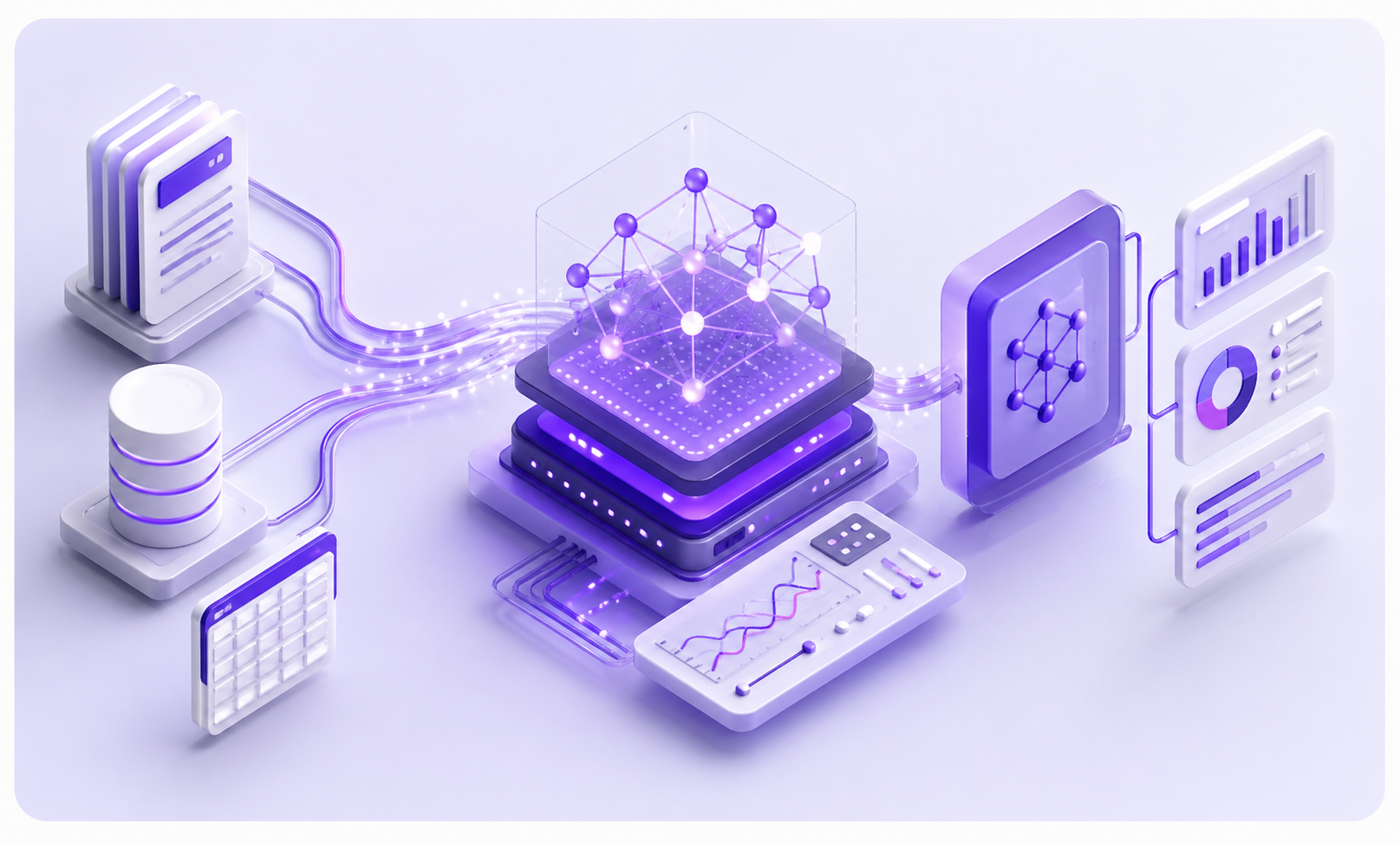
But RAG should be seen as one component inside a broader intelligence architecture.
The strategic shift is:
From document retrieval to decision reasoning.
From generic answers to specialist intelligence.
From isolated copilots to connected Brain Units.
From prompt engineering to governed architecture.
From AI experiments to enterprise cognitive systems.
From model dependency to owned decision capability.
This is the move from AI as a tool to AI as an enterprise intelligence layer.
How TekFrameworks Sees the Missing Intelligence Layer
TekFrameworks views the next stage of enterprise AI as a move toward governed, modular, and specialist intelligence systems.
Through concepts such as Cortexa, Mind Assemblies, Brain Units, and Cognitive Fabric, TekFrameworks is focused on helping enterprises move beyond fragmented pilots and generic AI deployments.
This approach is designed to support:
Specialist domain intelligence
Governed decision-making
Enterprise memory
AI portfolio scalability
Role-aware reasoning
Human oversight
Auditability and control
Cross-functional coordination
Enterprise-owned intelligence architecture
The goal is not simply to add AI to existing systems. The goal is to create a cognitive layeer that helps enterprises reason, decide, and act with greater clarity, speed, and accountability.
Conclusion: The Future Is Not Bigger Models - It Is Governed Intelligence
RAG and generic LLMs have an important place in enterprise AI. They improve access to information, accelerate knowledge work, and make AI more useful across everyday workflows.
But they are not enough for enterprise decision-making at scale.
RAG is not a brain. A generic LLM is not an enterprise operating model. A chatbot is not a decision architecture.
Complex enterprises need intelligence that is specialist, governed, auditable, role-aware, memory-enabled, and aligned with business authority.
That is why enterprise cognitive architecture matters.
The future of enterprise AI will not be defined only by bigger models. It will be defined by better intelligence architecture.
Enterprises that build this layer will move beyond AI experimentation. They will create governed intelligence systems that support decisions, improve accountability, and scale across the organization.
Call to Action
Explore how TekFrameworks is building the enterprise cognitive layer for governed, scalable AI decision-making through Cortexa, Mind Assemblies, Brain Units, and Cognitive Fabric.
FAQs
What is enterprise cognitive architecture?
Enterprise cognitive architecture is a governed AI architecture that structures how intelligence, reasoning, memory, tools, policies, and decision ownership work across the enterprise. It helps organizations move beyond isolated AI tools toward scalable, auditable decision systems.
What are the main RAG limitations in enterprise AI?
The main RAG limitations include weak reasoning, limited persistent memory, dependency on retrieval quality, lack of decision accountability, governance gaps, and limited ability to handle complex cross-functional enterprise workflows.
Why are generic LLMs not enough for enterprise decision-making?
Generic LLMs are broad language systems, not enterprise-specific decision architectures. They may lack domain specialization, role alignment, persistent memory, auditability, cost efficiency, and enterprise ownership.
What is a Brain Unit?
A Brain Unit is a domain-specific intelligence node designed around a business capability such as finance, compliance, HR, legal, or analytics. It includes domain knowledge, reasoning logic, memory, governance, approved tools, and role-based controls.
What is Cognitive Fabric
Cognitive Fabric is a governed mesh that connects Brain Units across the enterprise. It routes tasks, enforces policy, manages permissions, supports observability, shares knowledge, and enables coordinated AI decision-making.
How is Cognitive Fabric different from RAG?
RAG retrieves information from documents or databases to support model responses. Cognitive Fabric coordinates specialist intelligence units, governs decision flows, preserves memory, routes tasks, enforces policy, and supports auditability.
Why does agentic AI need governance?
Agentic AI can plan, use tools, and act across workflows. Without governance, it can create operational, compliance, security, and accountability risks. Governed agentic AI ensures permissions, controls, monitoring, and human oversight are built into execution.
Which industries need enterprise cognitive architecture most?
Enterprise cognitive architecture is especially important for regulated and complex industries such as finance, healthcare, pharma, insurance, manufacturing, and the public sector, where decisions require governance, auditability, risk controls, and accountability.